Prices · Dec. 8, 2026 · 7 min
Why Do Prices End in .99? Before You Buy Gifts
Premieres Dec. 8, 2026 on YouTube
The short answer
- The popular cash register story is widely told, but in what we could read, no document from the time backs it up.10
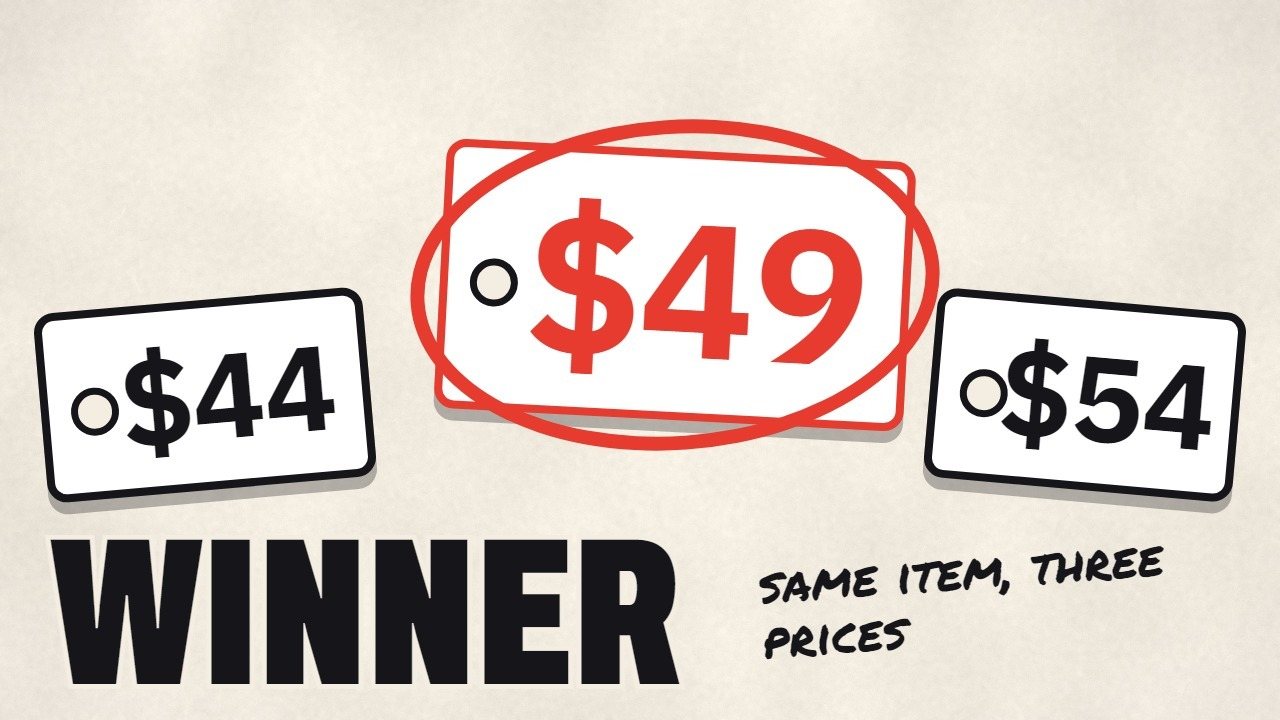
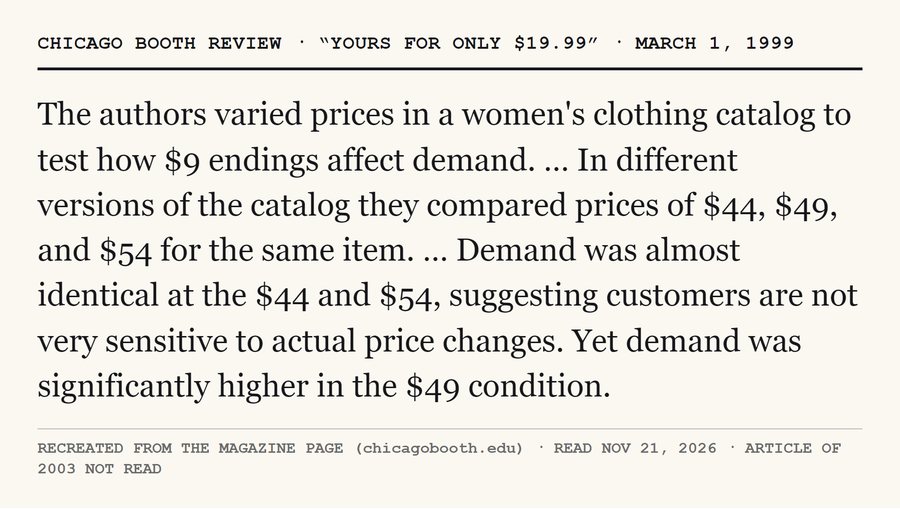
- In a catalog test, demand was almost the same at $44 and $54, yet significantly higher at $49.2 In lab studies, a nine ending made a price feel lower only when it changed the first digit.3
- The same left-digit bias shows up in used-car sales, where there is no price tag at all.6 None of the studies we read measured your total bill.
00:00
Why would a $49 price beat a $44 price?
A catalog sold more of an item at $49 than at $44. It was the same item in the same catalog. In that test, demand at $44 and at $54 was almost the same, and $49 beat both.2
It is gift shopping season, and you are about to read a lot of nines. So why would a nine beat a cheaper price?
You have probably heard the story: prices end in nine so the clerk has to open the drawer to make change. We went looking for the proof.
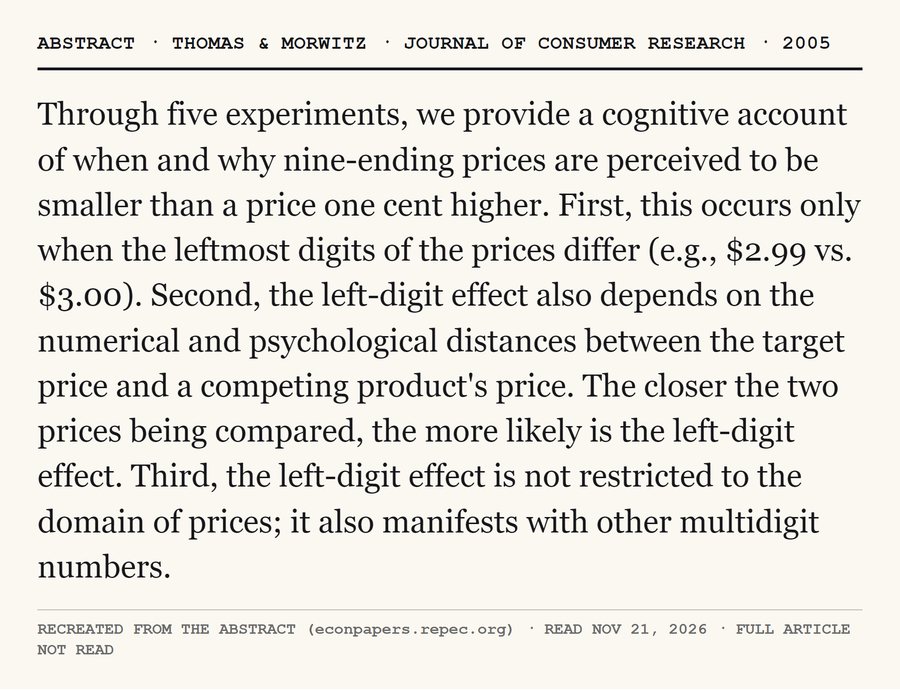
One line to keep in mind. A 2005 paper says the effect it studies "is not restricted to the domain of prices."3
Swipe sideways to read the full line.
00:51
Did prices end in nine because of the cash register?
In 1879, a saloon owner in Dayton, Ohio, patented a cash register.10 Then, the story goes, shops priced things at ninety-nine cents so the clerk had to open the drawer to make change.10
We looked for a document from the time. In what we could read, there isn't one. The pages that repeat the story point to books we could not open.10
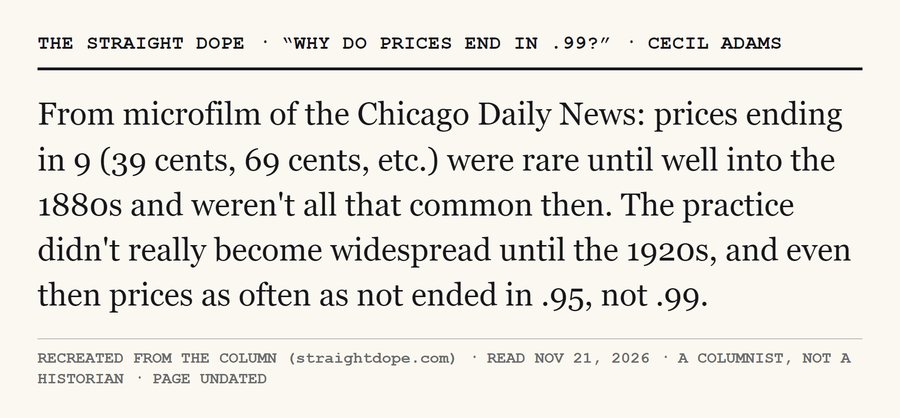
One columnist did check old Chicago newspapers on microfilm. Prices ending in 9 were rare until well into the 1880s, he wrote, and the practice did not become widespread until the 1920s. Even then, prices ended in .95 as often as not.10
That is one columnist, not a historian. A story that gets told is not a proven fact. By our reading, it also cannot explain the catalog, where a shopper never meets a clerk. So what does a nine do inside a shopper's head?
Swipe sideways to read the full line.
01:59
Do prices ending in 9 really raise sales?
Eric Anderson and Duncan Simester ran three field experiments, published in 2003, in which they changed price endings on purpose. A nine ending raised demand in all three.1
The lift was stronger for new items. The abstract also adds a catch: some evidence that nine endings are less effective when retailers use "Sale" cues.1 In December, when items carry sale signs, that is worth remembering.
We could not open the full paper, so we cannot give sample sizes.1
An economist at Chicago Booth studied supermarket scanner data on thousands of products sold by dozens of chains. In his data, demand drops when a price crosses into the next dollar.7 So the direction holds up. The size comes later.
One more thing to hold on to: $44 and $49 start with the same digit.
03:10
Does the first digit of a price matter most?
In 2005, Manoj Thomas and Vicki Morwitz published five experiments. In the first, 52 undergraduates judged whether a pen's price was high.34
A nine ending made a price feel lower only when it changed the first digit. $2.99 against $3.00 did. At other price levels in the same test, the effect did not show.34
Four years later, Kenneth Manning and David Sprott asked people to choose between two gifts. With prices of $29.99 and $39.99, only 25 percent picked the higher-priced gift. With round prices, twice as many did.5
Both are lab studies. A lab shows a mechanism, not what happens in a store. So what happens where nobody is selling anything?
Swipe sideways to read the full line.
04:12
Does it work where there is no price tag?
The abstract of that 2005 paper had a line: the left-digit effect "is not restricted to the domain of prices."3 Here is what that looks like.
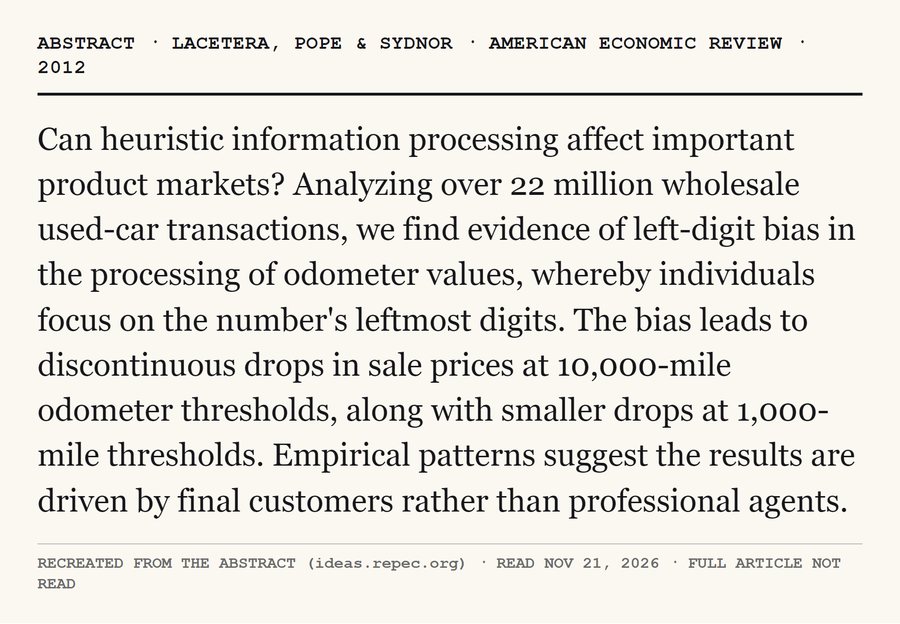
A study of more than 22 million wholesale used-car sales looked at the odometer. Cars with mileage in the 79,900s sold for about $210 more than cars just past 80,000 miles. Compared with cars a hundred miles lower, the difference was about $10.6
No price tag. No cents. No store.
It is not only about prices. It is about how we read numbers: left to right, and the first digit counts most. That is our synthesis of the used-car study and of Thomas and Morwitz, who write that "we process data from left to right."346
Swipe sideways to read the full line.
05:11
How big is the .99 effect?
Avner Strulov-Shlain estimated the size from scanner data. His published estimate: shoppers react to a one-cent increase from a 99-ending price as if it were more than a 20-cent increase.7 That is one study and a modeled estimate. Treat it as a size, not a law.
Stores price as if the bias were much smaller than it is. By his estimate, retailers give up 1 to 4 percent of potential gross profit. So the nine may work better than the stores assume.7
Now back to the catalog. $44 and $49 share a first digit, so a left-digit effect cannot explain why $49 won.13
The abstract points elsewhere. Nines may work better when customers have limited information, and there is some evidence they work less well beside a sale sign.1 Our reading: sometimes a nine is not a lower number. It is a signal. We cannot confirm that without the full paper.
06:23
What do the studies not show?
None of the studies we read measured your total bill.
Manning, one of the gift researchers, said that when buying a gift for a very close friend, or when only a few dollars are involved, round versus just-below pricing had no impact on choice.5
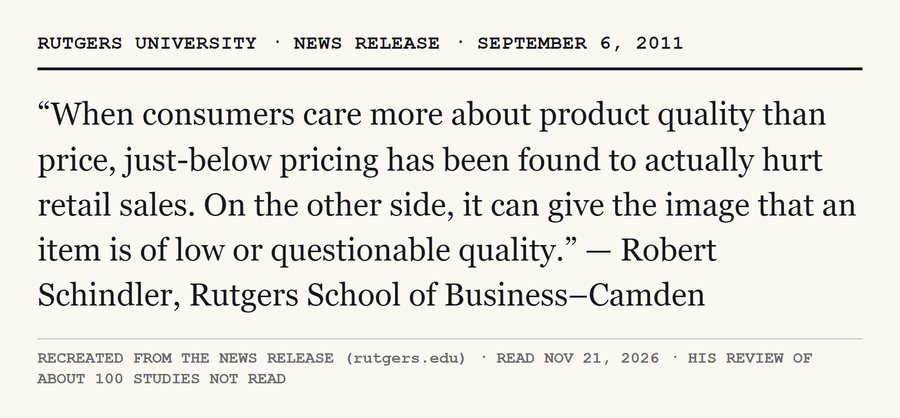
Robert Schindler, a researcher at Rutgers, said in a 2011 press release that when people care more about quality than price, just-below pricing has been found to hurt retail sales. It can also give the image that an item is of low or questionable quality.8 We could not read the review of about 100 studies he mentioned.
Swipe sideways to read the full line.
07:30
What should you do when you see a nine?
When you see a nine, say the price out loud, rounded up. $19.99 is $20. If the round number feels different, that is your first digit talking. That habit is our reading of the left-digit studies, not shopping advice.37
A catalog sold more at $49 than at $44, and not because it was lower. A nine doesn't make a price lower. It makes it look like a deal.
Questions people ask
Do .99 prices work when you buy a gift?
One researcher said that when buying a gift for a very close friend, or when only a few dollars are involved, round versus just-below pricing had no impact on choice.5
Can a nine ending hurt sales?
Robert Schindler, a researcher at Rutgers, said in a 2011 press release that when people care more about quality than price, just-below pricing has been found to hurt retail sales. It can also give the image that an item is of low or questionable quality. We could not read the review of about 100 studies he mentioned.8
When did prices ending in nine become common?
One columnist who checked old Chicago newspapers on microfilm wrote that prices ending in 9 were rare until well into the 1880s, and the practice did not become widespread until the 1920s. Even then, prices ended in .95 as often as not. That is one columnist, not a historian.10
Does a sale sign change how well a nine works?
The abstract of the field-experiment paper says a nine ending raised demand in all three experiments, and that the lift was stronger for new items. It also adds some evidence that nine endings are less effective when retailers use "Sale" cues. We could not open the full paper.1
Sources
Every source we used, with its link. The numbers in the article point here.
- The catalog field experimentsAnderson & Simester (2003), "Effects of $9 Price Endings on Retail Sales: Evidence from Field Experiments," Quantitative Marketing and Economics 1(1): 93 to 110 (abstract read)
- The $44, $49 and $54 comparisonChicago Booth Review, "Yours for only $19.99," March 1, 1999 (source of the $44 / $49 / $54 comparison)
- Left-digit effect in the labThomas & Morwitz (2005), "Penny Wise and Pound Foolish: The Left-Digit Effect in Price Cognition," Journal of Consumer Research 32(1): 54 to 64 (abstract read)
- Reading numbers left to rightSternBusiness (NYU Stern), "A Penny Saved," 2005
- Gift choices in a lab studyManning & Sprott (2009), "Price Endings, Left-Digit Effects, and Choice," Journal of Consumer Research 36(2): 328 to 335 (abstract read)Colorado State University news release, Feb 24, 2009
- Used cars and odometer thresholdsLacetera, Pope & Sydnor (2012), "Heuristic Thinking and Limited Attention in the Car Market," American Economic Review 102(5): 2206 to 2236 (abstract read)NBER Digest, Sept 2011
- Scanner data and the size of the effect one studyStrulov-Shlain (2023), "More than a Penny's Worth: Left-Digit Bias and Firm Pricing," Review of Economic Studies 90(5): 2612 to 2645 (abstract read; 2019 UC Berkeley thesis read in part)thesis
- Quality and just-below pricingRutgers University news release, Sept 6, 2011 (Robert Schindler)
- Another consumer research paperHodges & Chen (2022), Journal of Consumer Research 48(6): 1050 to 1072 (abstract read)
- The cash register storyCecil Adams, "Why do prices end in .99?", The Straight Dope (a columnist's reading of old newspapers; page undated)Wikipedia, "Psychological pricing" (CC BY-SA 4.0)
What this does and does not show
- We could not read the full text of sources 1, 3, 5, 6, 7 and 9, the cash register patent, or Schindler's review of about 100 studies.
- The $44, $49 and $54 figures come from a 1999 magazine summary of the field study.
- Effects here are measured on choices and demand for items, not on your total bill.
- This is an explainer of published research, not financial or shopping advice.
Credits
DEAL DECODED is an educational channel about the design behind prices, stores and brands. Nothing here is financial advice.
Voice and visuals are produced with AI tools; scripts are researched and fact-checked against the sources above.
Music: "Tiburtina" by Schwartzy, "Rain Over Kyoto Station" and "Jomon Grove" by The Mini Vandals (YouTube Audio Library).